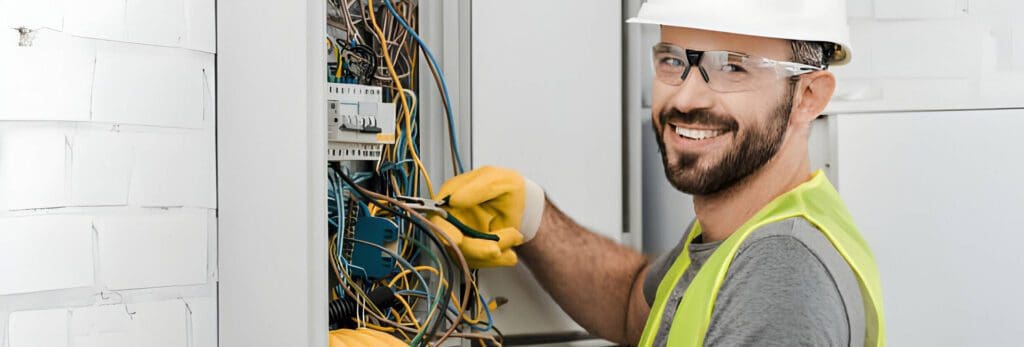
A short circuit occurs when the current finds a way to bypass the appliance on a path that has little or no resistance—for example, where frayed insulation bares a wire and allows it to touch the frame of the appliance, so the current can flow straight to the ground.
Definitely! We specialise in offering energy-efficient solutions for commercial businesses. Our team can conduct energy audits, recommend upgrades such as LED lighting installations, and suggest other energy-saving measures to help reduce your energy consumption and lower utility costs.
Yes, we can assist with various electrical issues, including power outages, circuit tripping, flickering lights, and other electrical problems. Our skilled electricians can diagnose the issue, perform the necessary repairs, and ensure your electrical system is functioning properly.
Yes. Because a ceiling fan is an active load that is heavier than most light fixtures, you need a special mounting box designed for this application. Saddle boxes are usually good for fans up to 35 pounds.
You can replace an electric shower yourself, but it’s generally recommended that you use an electrician. Even if you are replacing an electric shower with a similar model, it will require plumbing and electrical experience to ensure it’s done safely, especially if your new shower is of higher wattage.
Yes, we install electric vehicle (EV) charging points at homes and commercial premises. We can advise on the best type of charger for your needs, handle the installation safely, and ensure it meets current electrical regulations.
Yes we provide smart home installation services such as lights, thermostats, security cameras, and locks.
Yes, we provide landlord electrical safety certificates (EICR). These certificates are legally required for rental properties and confirm that your electrical system is safe for tenants. We carry out thorough inspections, identify any issues, and provide a detailed report.
We also provide EICR’s for landlords. Book Yours today
Yes, we provide emergency call-out services for urgent issues such as power failures, sparking outlets, or dangerous electrical faults. Our team prioritizes emergencies to ensure your home or business is safe and operational as quickly as possible. We also offer 24 hour callouts and advice over the phone.
Yes, we work with both residential and commercial clients. For homeowners, we handle everything from small repairs to full home rewires. For businesses, we offer installations, maintenance, and upgrades that ensure your premises are electrically safe and compliant.
The best way to find out if your electrical installation is safe is to have it inspected and tested by a person who has the competence to do so. Carl Ashley Electrical Services are qualified electricians with years of experience.
It is possible to do simple checks on your installation, using an electrical socket tester. This is a device that can be plugged into a socket outlet to identify if there is a wiring fault. However, be aware that many types of socket tester can’t detect certain types of fault, and could indicate the socket is safe when it actually isn’t.
When there is a power surge or increase in voltage, electrical current will quickly rise to dangerous levels which can potentially damage devices plugged into it.
Electrical surge protectors can absorb this energy through dissipating heat so your electronic equipment doesn’t.
Electrical surges can happen as a result of severe weather such as lightning strikes or when power grids overload from high electrical demand periods, usually in the late afternoons and evenings.
An electrical fuse is basically a safety device that stops the flow of electricity when there are problems.
Electrical fuses have two main functions, protecting the wiring and components from damage caused by too much current passing through them, and limiting short circuits within an appliance or circuit to prevent overheating which can cause fires.
Electrical fuses come in different sizes depending on the current (i.e., amps) they can handle without blowing out, and are marked with this information as well as their amperage rating.
Electrical fuses come in different types including cartridge fuses, plug-in fuses, mini fuse blocks or adapter plugs; each type has its own way of installing them into an electrical circuit.
Electrical fuses are rated in amps.
Electrical outlets and switches should be checked at least once a year. If you notice any problems such as flickering lights, which could be caused by an overloaded circuit, it may be time for a qualified electrician to check it out.
An electrical installation in a home should be checked out by an electrician every three – 5 years.
This is not only for safety purposes but to make sure that there are no power surges due to worn wires, faulty insulation, and other problems which could cause fires. In homes with small children & pets, it is important to check the wiring often as they are more likely to come into contact with the electrical system.
Low-voltage fixtures include a transformer to reduce voltage (say from 120 volts to 12 volts). The downside to low-voltage fixtures, however, can be higher installation costs. Also, transformers tend to create heat and mounting locations can be tricky.
Some of the most common electrical faults are overloaded or short circuits, damaged power outlets, tripped switches and loose connections.
We offer a full range of electrical services to meet both domestic and commercial needs. This includes electrical installations, rewiring, lighting, power points, fault finding, safety inspections, consumer unit upgrades, smart home installations, EV charging point installations, and general maintenance. Whether it’s a small repair or a large-scale project, we can handle it.
A short circuit occurs when the current finds a way to bypass the appliance on a path that has little or no resistance—for example, where frayed insulation bares a wire and allows it to touch the frame of the appliance, so the current can flow straight to the ground.
Amperage (amps) is a measurement of current flow in terms of electricity usage, similar to how we measure water flow in terms of gallons.
We are experienced at making the rewire as hassle and mess-free as possible, but unfortunately, rewiring is disruptive and invasive work. For a full rewire, every room will need to have the following carried out:
Furniture moved out, floor covering taken up, floorboards lifted, walls chased out for switches/sockets where necessary, dust and associated mess during the period of the work (although we always clean up at the end of the day). To rewire lighting upstairs, we will probably need the loft to be cleared to gain access to the lighting points and to each switch drop.
A watt is a unit of power and volts are a measurement of energy.
At Carl Ashley Electrical Services, our commercial electricians work across a range of commercial properties, some of which include warehouses, education facilities, public sector premises, and healthcare settings. We tailor each project to meet the electrical capacity, safety requirements, and layout of your commercial property. Reach out to us through our contact page.
The main difference between fuse and circuit breakers is that fuses cannot be reused while circuit breakers can be reused over and over again. Circuit breakers are used to protect homes and devices against overloading and short-circuiting while fuses protect devices and homes against overloading only.
Light switches can only handle so much power before they become overloaded. When a light switch becomes overloaded with power, it can overheat and be hot to the touch. While most light switches can handle no more than 15 amps of power, many electrical circuits use closer to 20 amps of power.
A short power outage can be expected on each circuit within the system but because most of the testing is carried out whilst the system is still live, these outages can be planned around your daily activities.